Recently, market commentators have been shouting from the rooftops about the relatively high valuations of the ‘Magnificent 7’ big tech stocks. While some concern may be warranted, in this edition of Basis Points, we dive into why we incorporate the ‘Size’ factor (targeting the return premium in Small Capitalisation stocks) to aid in diversification.
Diversification can help enhance a portfolio’s stability by preventing an investor from over-allocating to any specific security. Similarly, an investor who is overly focused on one segment of an asset class (large cap stocks for example) is missing out on a much broader investment universe. By adding smaller companies (or “Small Caps” as they’re known) to a portfolio, an investor can gain access to stocks that behave differently.
Given they are earlier in their growth cycle, small caps tend to have lower valuations, making them attractive relative to their large-cap counterparts. Not only can small caps be cheap, they also offer high growth potential considering they are often at the forefront of innovation and market disruption.
While smaller companies can be more sensitive to the economic cycle, they do not have the same constraints or slow decision-making processes that can beleaguer larger firms. This enables them to be more agile in adapting to changing economic conditions.
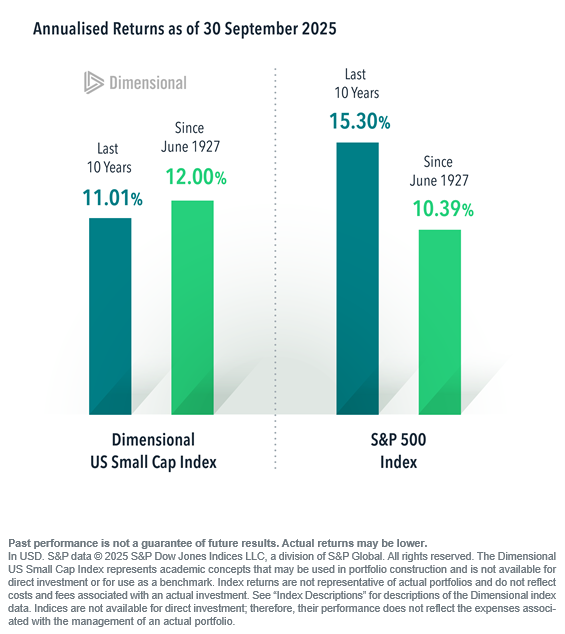
As the below graph demonstrates, the average annualised return of US small caps (measured by the Dimensional US Small Cap Index in USD) has outperformed the S&P500 (large US stocks) by 1.61% per annum for close to one hundred years.
The graph also shows that small caps have been more consistent with their longer-term average over the last 10 years than large caps, again demonstrating how, in aggregate, small caps can be a good diversifier in terms of smoothing volatility of a portfolio.
While small caps can be attractive for investors seeking higher growth potential, their smaller size can make them more sensitive to market swings, economic uncertainty, and company specific risks. That’s why when targeting small caps, it is important to invest in a broad basket of securities.
Our external small caps manager invests in over 4,000 small cap stocks globally on our behalf, ensuring that risk is minimised, while opening up the portfolios to the benefits that small caps offer in aggregate.
What we’re reading: Why Adding Small Cap Stocks to Your Portfolio Could Be a Smart Move