
Artificial Intelligence (AI) has moved from promises to practice in pharmaceutical Research and Development (R&D). After years of pilot projects and niche use cases, AI is now embedded across discovery pipelines at most major pharma companies and a growing cohort of AI-first biotech companies.
For investors, the question is no longer whether AI will shape drug discovery, but how this shift alters risk, returns, and competitive advantage.
From Experimentation to Adoption
AI adoption in drug discovery has crossed a critical threshold. Roughly 70% of pharmaceutical companies are investing meaningfully in AI across R&D, making it one of the most widely deployed digital technologies in the sector.
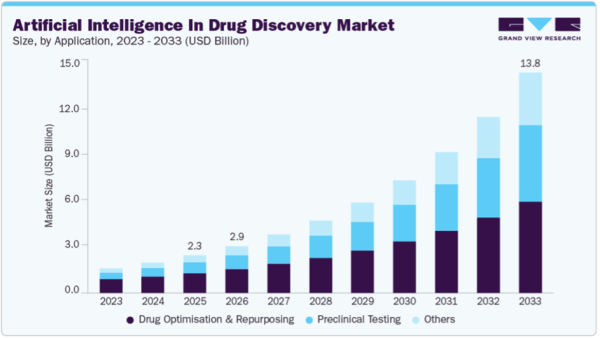
The global Artificial Intelligence (AI) driven drug discovery market is poised to grow from ~USD1.9 billion to USD$2.8 billion in 2026, with more than 200 AI-enabled clinical programs underway (and 15-20 entering pivotal trials this year).
Estimates are projecting a long-term compound annual growth rate of 25-30% through 2030-2034, potentially reaching USD$50 billion by 2034.
Economic Impact: Time, Cost and Capital Efficiency
The most compelling investment rationale for AI lies in its ability to compress timelines and improve capital efficiency at the most failure-prone stages of R&D. Traditional drug development typically spans 10-15 years and costs in excess of USD$1-2 billion per approved therapy. With AI delivering 25-50% reductions in preclinical R&D costs and up to 40% faster early discovery timelines, Phase I drug trial success rates are now approaching 80-90%, significantly outperforming traditional benchmarks of 40-65%.
While these statistics represent best-case or early-stage averages, even partial realisation has the potential for profound financial implications. Faster preclinical throughput increases optionality, lowers the cost of failure and allows capital to be redeployed across a broader range of projects.
While healthcare is very much a defensive sector, within this sector, we also target innovative healthcare companies who are positioned to benefit from the AI use cases and associated benefits discussed above. This helps to ensure we remain invested for the future, not the past.
Healthcare Innovation remains a key investment theme in 2026, and a key area of investment for the portfolios and funds. We balance risk and reward through diversification across geographies and sectors.
What we’re reading: Artificial Intelligence In Drug Discovery Market Report, 2033